
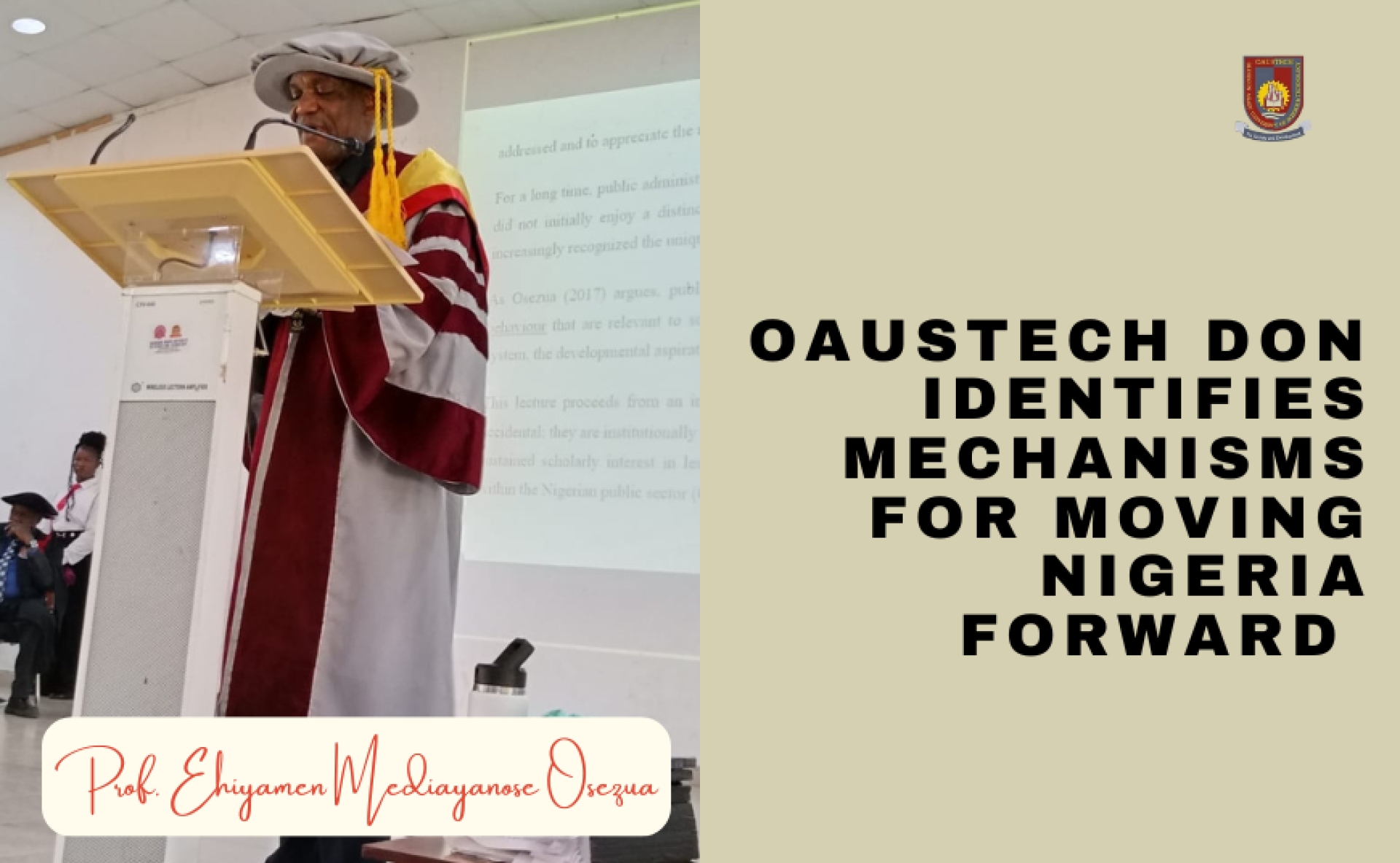
The professor of Public Administration stated this on Tuesday, 5th May , 2026, while delivering the University’s 11th Inaugural Lecture titled “Governing Without Results: Public Administration, Leadership and Institutional Failure in Nigeria. Quo Vadis?” at the main campus.
Prof. Osezua insisted that Nigeria’s progress will not depend on personalities but on rebuilding institutions that can outlive individuals, resist manipulation, and deliver tangible results to citizens.
He noted that the country’s tragedy is not the absence of institutions, talent, or resources, but the failure to mobilize them with integrity, discipline, competence, and developmental clarity. “That is why this lecture has spoken not merely of bad governance, but of governing without results,” he said.
According to the Dean of the School of Management, leadership and administrative failure has adverse effects on the economy and the lives of citizens. He identified the core challenges as patriotic leadership deficit, administrative weaknesses, corruption, political opportunism, judicial fragility, bureaucratic inefficiency, and social disconnection.
Despite these challenges, Osezua stressed that Nigeria’s condition is not irreversible. He emphasized that public administration can be renewed, leadership reformed, institutions recovered, and trust rebuilt if development is pursued with seriousness and fairness.
To address institutional failure, he recommended re-establishing merit as the cornerstone of public service recruitment and promotion, institutionalizing ethical governance, and enforcing consequences for misconduct. He also called for strengthening accountability systems across Ministries, Departments, and Agencies.
Other recommendations include adopting Results-Based Governance as a national administrative principle, expanding e-governance and digital public administration, reducing the cost of governance, and reordering public expenditure toward development. He further urged the combating of corruption and the deepening of democratic institutions.
Osezua also advocated building citizen trust through reliable public service delivery, repositioning academia as an institution of national renewal, reforming bureaucracy as the engine room of the state, and restructuring Nigeria as a federation to correct imbalances. He added that traditional institutions, core social values, and religious bodies must also play defined roles in national reconstruction.
In his remarks, OAUSTECH Vice-Chancellor, Prof. Temi Ologunorisa, commended the lecture as a “fantastic presentation” meant to address leadership decay and administrative imbalances. He urged government and public sector actors to adopt the recommendations for a desired national rebirth.
The lecture was attended by scholars, government functionaries, legal experts, traditional rulers, religious leaders, secondary school students, families, and staff and students of the University.
Source:
Directorate of Information, Protocol and Public Relations (DIPPR),
OAUSTECH