
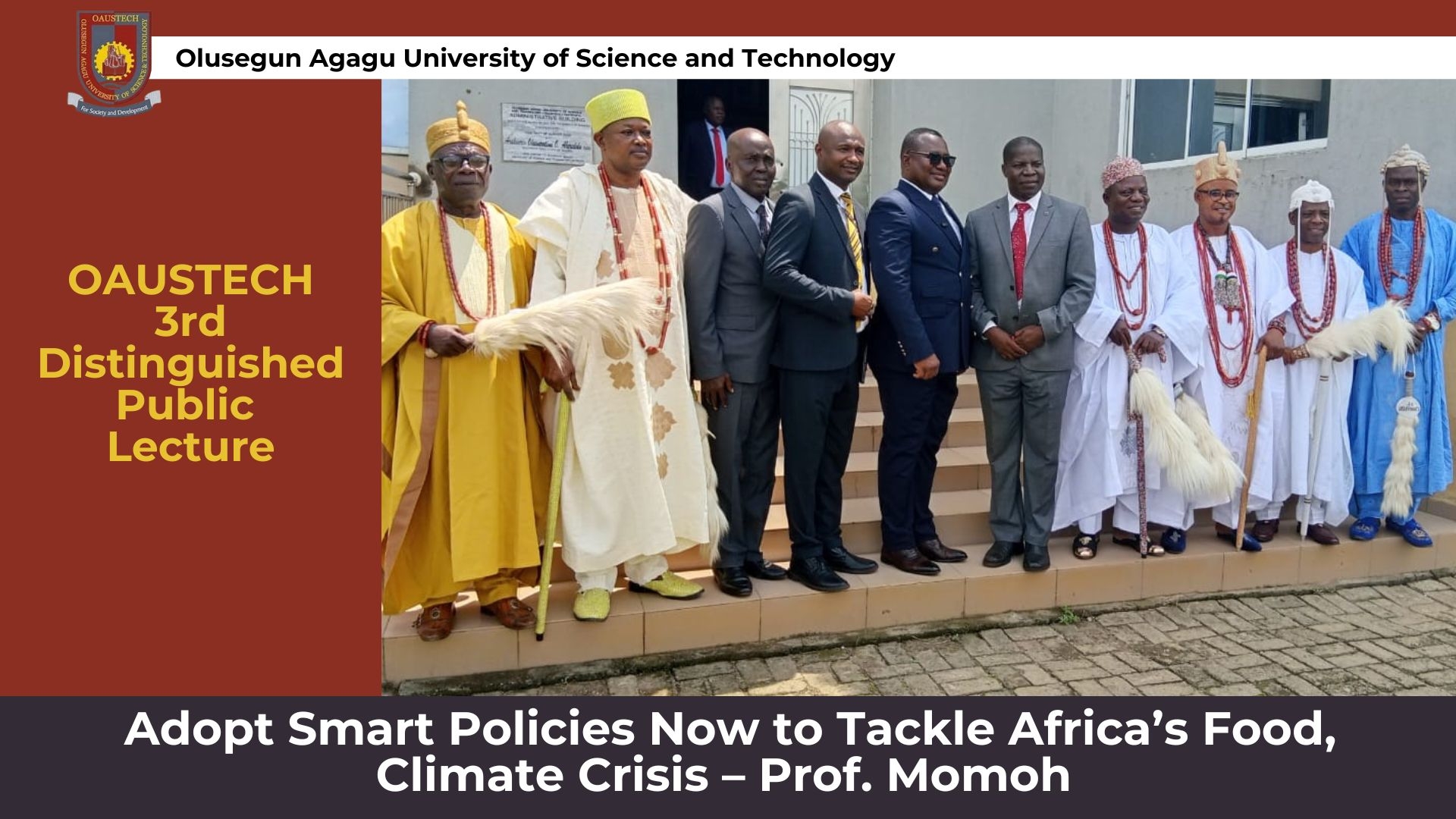
The call was made by Prof. Edwin Momoh, Vice-Chancellor and Principal of Ernest Bai Koroma University, Sierra Leone, at the 3rd Distinguished Public Lecture of Olusegun Agagu University of Science and Technology (OAUSTECH), Okitipupa, Nigeria held on Wednesday, 24th June, 2026.
Delivering a lecture titled “Climate Change and Food Security in Africa: Impact on Agriculture, Access and Adaptation”, the renowned crop scientist said human activities such as fossil fuel burning, deforestation, industrial emissions, and unsustainable farming are driving modern climate change.
He described climate change as “the most profound global challenge of the 21st century,” with agriculture as the main channel of impact in Africa.
“Africa contributes minimally to global greenhouse gas emissions, yet it is one of the most vulnerable continents,” Prof. Momoh said. “Agriculture is the backbone of many African economies and the primary source of food and livelihoods for millions.”
He listed the visible impacts as rising temperatures, erratic rainfall, frequent droughts and floods, erosion, desertification, and destabilized climate systems.
Prof. Momoh said the crisis also presents opportunities for innovation, economic diversification, and stronger regional cooperation.
He recommended: Climate-Smart Agriculture, CSA and Climate-Resilient Food Systems (CRFS), Water-Energy-Food Nexus (WEF) approach to cut greenhouse gas emissions, development of drought-tolerant, heat-resistant, flood-tolerant, and short-duration crop varieties, as piloted in Sierra Leone, high-precision ecosystem monitoring, agro-ecological and nature-based solutions, and scaling climate information services and financing smart technologies, including AI tools
“Moving forward requires unequivocal government commitment and sustained investment in research, people, and institutions,” he said. “By combining gender equity, social protection, market access, and ecological innovation, policymakers can reduce vulnerability and build food systems that absorb, adapt, and transform in a warming climate.”
Chairman of the occasion, HRM Prof. Oba Sunday Amuseghan, the Kalasuwe of Apoiland and Pro-Chancellor of University of Fortune, Igbotako, said the lecture was “apt and timely” for Africa’s survival.
OAUSTECH Vice-Chancellor, Prof. Temi Ologunorisa, in his welcome address, urged individuals, organizations, and governments to intensify tree-planting campaigns.
“Planting trees absorbs carbon causing global warming and releases oxygen that protects human health and prolongs life,” he said.
The event featured the presentation of an award to Prof. Momoh and was attended by scholars, policymakers, traditional rulers, community leaders, clerics, agricultural practitioners, security chiefs, staff, students, and members of the public.
Source:
Directorate of Information, Protocol and Public Relations (DIPPR),
OAUSTECH