
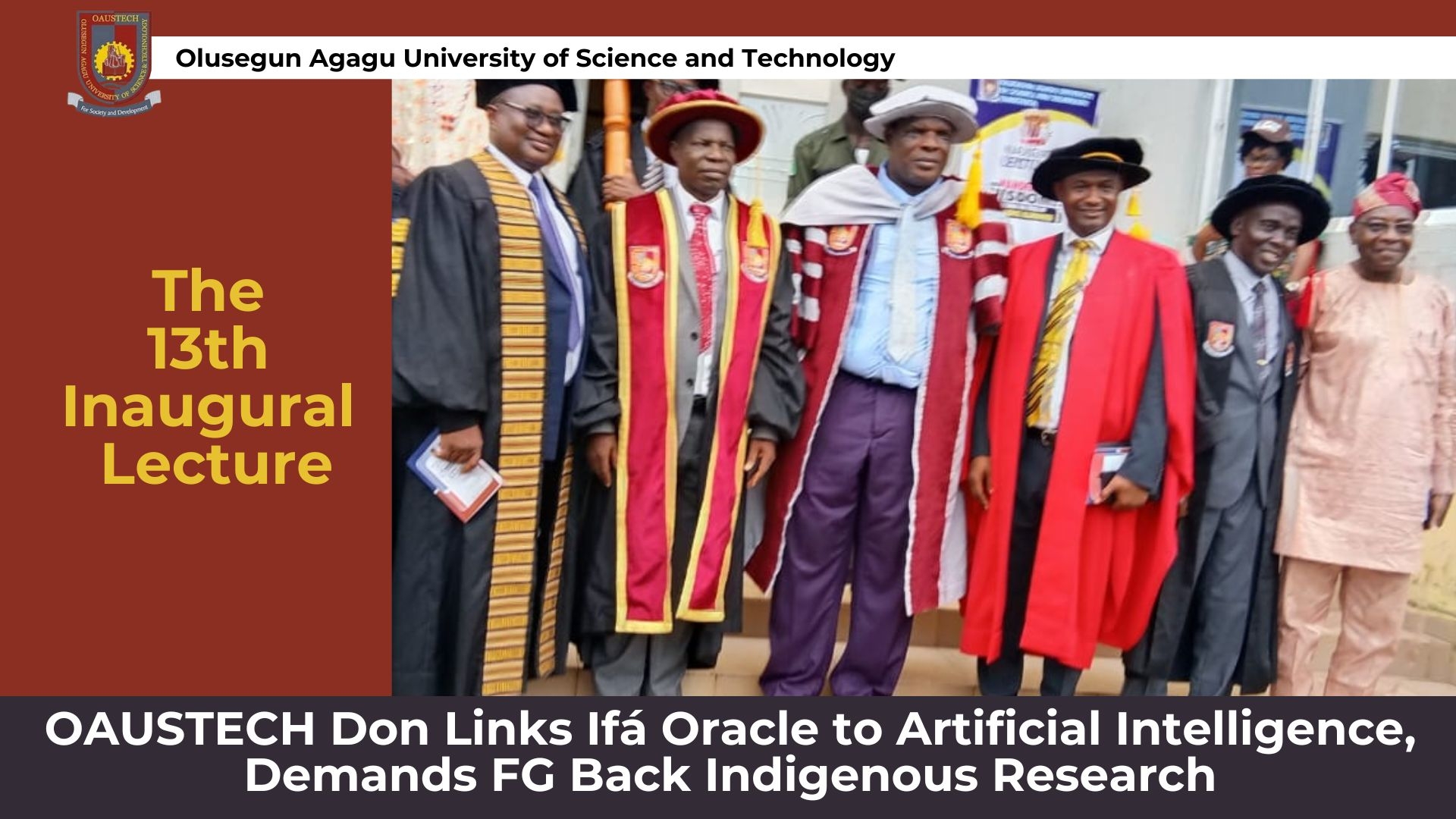
Delivering OAUSTECH’s 13th Inaugural Lecture on Wednesday, 24th June, 2026, Prof. Dipo Theophilus Akomolafe titled his presentation “From Wandering to Wisdom: Breaking The Cycle of Intelligence Blindness.”
Prof. Akomolafe said humanity now lives in the “most informed age in history,” with centuries of knowledge accessible on mobile devices and data moving at unprecedented speed.
Yet, he warned, Nigeria is trapped in what he called “intelligence blindness.”
“Human civilization evolved through continuous quests for knowledge. However, societies have often operated within cycles of uncertainty and underutilization of available knowledge… a state in which valuable information, indigenous knowledge, or strategic insight exists, but is either ignored, misunderstood, or inadequately applied,” he said.
The result, he noted, is “confusion where clarity should prevail, division where there should be discernment, and repeated mistakes where results should guide.”
The Professor of Computer Science and Digital Forensics traced modern computing to African knowledge systems.
“Orunmila used codes same as binary digits to access divine messages, thereby establishing computer cognizance among contemporary humans,” Prof. Akomolafe argued.
He explained that while computer programming relies on the binary system, Yoruba anthropomancy employs a similar binary logic, with values in powers of two. Through the opele chain, “bi pairs” are keyed as 0 and 1, forming what he described as a classical 16-digit Ifá computer network.
“Ifá was the bedrock upon which the technological advancement we see today. computer systems, phones, AI and other digital tools was built,” he said.
Prof. Akomolafe criticized the disconnect between research funding and policy implementation.
“The Federal Government, through TETFund, spends billions of naira yearly on research, but the outcomes are dumped on the shelves afterwards without implementation,” he lamented.
He urged federal, state, and local governments to fund research into indigenous knowledge and translate university outputs into solutions for education, security, and industrialization.
OAUSTECH Vice-Chancellor, Prof. Temi Ologunorisa, said the lecture proved that AI is not a new concept to Africa, only an undocumented one.
“The message is clear: government should commit resources to developing AI as part of our indigenous knowledge,” Prof. Ologunorisa said. “That is how we can drive development for the good of our nation and its people.”
The lecture drew academics, traditional rulers, staff, students, family, friends, and members of the public.
Source:
Directorate of Information, Protocol and Public Relations (DIPPR),
OAUSTECH