
OAUSTECH Newsletter - September 2025


 Wednesday, 15 October 2025 11:06
 1.75 MB
 3,571
3,571AKUNGBA STANDS STILL AS OAUSTECH VC, FAMILY BID OLOGUNORISA MATRIARCH FAREWELL

AKUNGBA STANDS STILL AS OAUSTECH VC, FAMILY BID OLOGUNORISA MATRIARCH FAREWELL

OAUSTECH Receives NUC Approval for New Programmes

OAUSTECH Receives NUC Approval for New Programmes

Prof. Temi Ologunorisa Elected President of Nigerian Academy of Social Sciences

Prof. Temi Ologunorisa Elected President of Nigerian Academy of Social Sciences

Department of Computer Science

HISTORY
The Department of Computer Science is one of the foundational pillars in the academic evolution of Olusegun Agagu University of Science and Technology (OAUSTECH), Okitipupa. Its history dates back to the early years of the institution—formerly known as the Ondo State University of Science and Technology (OSUSTECH)—where Computer Science emerged as a pioneering programme within the Department of Mathematical Sciences, Faculty of Science.
Early Beginnings (2010 – 2012)
The Computer Science programme officially commenced during the 2010/2011 academic session with the admission of eighteen (18) foundation students into the Bachelor of Technology (B.Tech.) degree programme. At inception, the programme did not operate as an independent department but was coordinated from the Office of the Acting Dean, Faculty of Science. This early structure allowed the programme to take off smoothly while laying the foundation for its future expansion.
By 2012, the Department of Mathematical Sciences—which housed both Mathematics and Computer Science—was headed by Dr. E. A. Okeyinka (now Professor E. A. Okeyinka, Emeritus Professor of Computer Science). His leadership marked a period of structural organization and academic development within the nascent programme.
Growth Under the Department of Mathematical Sciences (2012 – 2020)
Following Dr. Okeyinka’s tenure, the leadership of the Department of Mathematical Sciences transitioned to the late Professor T. G. Okedayo, who was appointed to oversee activities related to both Mathematics and Computer Science programmes. His administration strengthened academic coordination and expanded the operational capacity of the department.
The leadership progression continued with:
1. O. T. Amumeji
2. E. A. Oyekan
3. A. J. Ikuomola
During this period, the Computer Science programme operated as a unit under the Department of Mathematical Sciences, one of the four departments in the School of Sciences. The programme’s philosophy was deeply rooted in producing technologically competent graduates equipped to respond to societal needs in diverse computing fields.
Transition to a Full-Fledged Department (2020/2021 Academic Session)
A major milestone in the programme’s development came in the 2020/2021 academic session, when the Computer Science unit evolved into a full-fledged Department of Computer Science under the School of Science and later placed under the newly established School of Information and Communication Technology now School of Computing in October 2024. This transition aligned with global trends in computing education and reflected the University's commitment to strengthening ICT-driven academic programmes.
The pioneer Head of the Department of Computer Science was Professor A. J. Ikuomola, whose visionary leadership laid the groundwork for departmental autonomy, curriculum enhancement, laboratory expansion, academic staff development, research output and played a significant role in strengthening research visibility and academic restructuring within the department.
He was succeeded by Professor Adebayo Adetunmbi, who served as Head of Department while on sabbatical.
The Department is currently headed by Dr. O. A. Gbadamosi, under whose leadership the department continues to expand in instructional quality and student support services.
Academic Staff Strength and Learning Facilities
The department currently boasts:
1. Seven (7) full-time academic staff
2. Three (3) adjunct academic staff
3. One (1) administrative staff
To support teaching and learning, the department maintains well-designed and fully equipped laboratories used for practical sessions in programming, networking, software development, database management, and emerging technologies.
Programme Structure and Curriculum Development
From inception, the Computer Science programme has offered courses leading to the B.Tech. (Honours) degree in Computer Science, anchored strictly on the National Universities Commission (NUC) prescribed syllabus. With the introduction of the NUC Core Curriculum and Minimum Academic Standards (CCMAS), the programme has continued to update its curriculum to reflect national standards and global best practices.
The curriculum covers a broad spectrum of ICT and computing fields, including:
1. Computer Programming
2. Algorithms and Data Structures
3. Software Engineering
4. Computer Networks
5. Artificial Intelligence
6. Database Systems
7. Web Technologies
8. Operating Systems
9. Computer Architecture
10. Information Security
11. Entrepreneurship in ICT
The programme is structured to produce graduates equipped for careers as software engineers, computer programmers, system analysts, computer/network engineers, ICT consultants, cybersecurity analysts, researchers, and entrepreneurs.
Academic Achievements and Graduate Output
The historic pioneering set of the programme completed their studies and graduated during the 2014/2015 academic session. Since then, the department has produced multiple sets of graduates who have excelled in the private sector, public sector, academia, entrepreneurship, and global ICT industries.
Postgraduate Programme Development
In addition to its undergraduate offerings, the Department of Computer Science has expanded its academic portfolio to include postgraduate programmes, which are now in their third academic session. These programmes strengthen research, innovation, and the development of advanced computing expertise, affirming the department’s commitment to contributing to national and global ICT advancement.
The Department of Computer Science continues to play a central role in the transformation of ICT education at OAUSTECH. With sustained faculty development, infrastructure growth, research productivity, and strong administrative leadership, the department remains committed to producing highly skilled graduates capable of driving technological innovation and digital transformation across Nigeria and beyond.
Departmental Staff
1. Prof. Aderonke Justina Ikuomola | Dean (School of Computing)
2. Prof. Dipo Theophilus Akomolafe | Professor (DVC Admin)
3. Dr. Gbadamosi Omoniyi Ajoke (PhD) | Coordinator (Department)
4. Dr. Modupe Agagu | Lecturer II
5. Mr. Oduwale, Adeyemi Michael | Lecturer II
6. Mr. Adeolu Seun Obamehinti | Lecturer II
Programmes Information
|
S/N |
PROGRAMME |
AWARD |
DURATION |
INFO |
|
1. |
Computer Science |
Bachelor of Science (B.Sc.) |
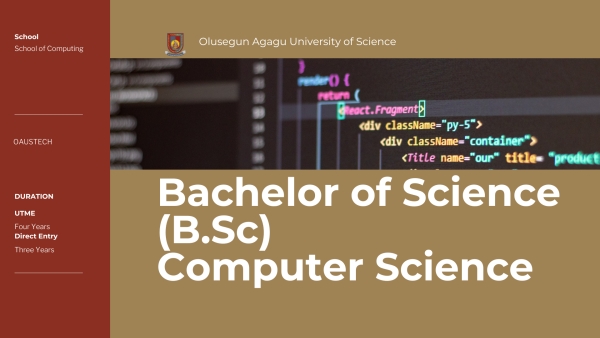
1. UMTE: 4 Years 2. Direct Entry: 3 Years |
B.Sc Computer Science
Philosophy of the Programme
The degree programme in computer science has been designed in such a manner to cover the art, science, engineering and technology of computers and information technology. The students are developed to meet the challenges of self, private and public employment involving the computer hardware system studies, design, assembling, construction, operation and maintenance; computer software system studies, prototyping, development, implementation, documentation and maintenance; fundamentals of informatics; database systems and expert systems; numerical computation, and theoretical computer science.
The programme objectives are to:
- Provide and promote sound practical and theoretical training in computer hardware, software and application areas that will make the students useful in private and public sectors of the economy.
- Identify the basic problems of the society and find appropriate computer solutions to them.
- Develop and offer service courses in computer science and information technology to other departments in the university.
- Equip the students with the capacity for professional practice in information technology. Develop the students for self-employment and job placements in the government and industry.
- Develop the students through sound academic and professional programmes as a basis, for postgraduate studies
ADMISSION REQUIREMENTS INTO COMPUTER SCIENCE PROGRAMME
- Admission Through UTME
Five (O) Level credit passes in English Language, Mathematics, Physics and any two from Chemistry, Biology, Further Mathematics, Data processing, Computer Studies, Statistics, Geography and Economics.
UTME Subjects
A candidate must sit for English Language, Mathematics, Physics and any one of Chemistry/Biology/Geography/Economics.
- Direct Entry Admission
- Advanced Level passes in Mathematics and in at least two other subjects from Physics, Chemistry, Biology and Economics.
- Candidates from Polytechnics and other related programmes MUST possess a minimum of upper credit at any level of the programme (i.e. ND, HND, NCE e.t.c)
NOTE: Any combination of GCE ‘O’ Level Certificate, IJMB ‘O’ Level Certificate, Cambridge ‘O’ Level Certificate, NABTEB ‘O’ Level Certificate, NECO ‘O’ Level Certificate and any acceptable equivalent will be considered.
PROGRAMME DURATION
The duration for the BSc. Computer Science shall be four academics sessions for students that entered the university by UTME admission and three academic sessions for those by direct entry admission.
Additional Info
- Schools Computing
- Duration 4 years
- Department Computer Science
- Accreditation Status Full Accreditation
- Courses Link Apply Now
Department of Cyber Security

HISTORY
The Department of Cybersecurity is one of the pioneering pillars in the evolution of the School of Computing at Olusegun Agagu University of Science and Technology (OAUSTECH), Okitipupa. As digital transformation accelerated globally and cybersecurity threats became increasingly sophisticated, the University recognized the critical need to develop a specialized academic unit dedicated to producing experts capable of protecting information systems, digital infrastructures, and national assets. This recognition gave birth to the Department of Cybersecurity.
Formal approval for the establishment of the department was granted by the National Universities Commission (NUC) in October 2025. The approval followed a successful NUC resource verification exercise, during which the University’s facilities, staffing, curriculum quality, and readiness to host the programme were thoroughly assessed and certified as meeting national standards.
Following NUC approval, the department was officially created in 2025 and commenced full academic operations in the 2025/2026 academic session. It became the second department to be established under the School of Computing, reflecting the University’s commitment to expanding academic offerings in response to global technological demands.
The pioneer Head of Department (H.O.D) is Professor A. J. Ikuomola, an accomplished scholar and cybersecurity expert whose leadership played a foundational role in setting the academic, administrative, and developmental direction of the department. Under his stewardship, the department laid its initial structures, established its academic culture, and aligned its teaching and research priorities with national and international best practices.
The department offers academic programmes leading to the Bachelor of Science (B.Sc.) Honours degree in Cybersecurity. The curriculum is fully designed in accordance with the NUC Core Curriculum and Minimum Academic Standards (CCMAS) for Cybersecurity, ensuring that students receive comprehensive training in core areas such as digital forensics, ethical hacking, information assurance, cyber laws and policies, cryptography, secure software development, network defense, and emerging technologies in security.
The Department of Cybersecurity continues to distinguish itself as a forward-thinking academic unit dedicated to research, innovation, skill development, and professional excellence. It aims to produce graduates who are industry-ready, ethically grounded, globally competitive, and capable of addressing real-world cybersecurity challenges across national and international domains. Through quality teaching, research, partnerships, and community engagement, the department contributes significantly to OAUSTECH’s mission of advancing science, technology, and global digital security.
Departmental Staff
1. Prof. Aderonke Justina Ikuomola | Dean (School of Computing)
Programmes Information
|
S/N |
PROGRAMME |
AWARD |
DURATION |
INFO |
|
1. |
Cyber Security |
Bachelor of Science (B.Sc.) |
1. UMTE: 4 Years 2. Direct Entry: 3 Years |
Subscribe to our Newsletter
About OAUSTECH
Olusegun Agagu University of Science and Technology (OAUSTECH), Okitipupa was established by the Ondo State government in 2008. It was initially named as Ondo State University of Science and Technology (OSUSTECH).
It is a technology-based institution, which aims at providing the needed manpower training for industrial and technological development of Ondo State and Nigeria as a whole.